- Contact us:
- 03300 535 600
- [email protected]


Smart Glasses in the Workplace: Why Staff One Has Issued New Guidance for Our Care Teams
July 21, 2026
October 2026 is the busiest month yet for UK employment law. Two dates matter: 1 October, when tribunal time limits doubled and right to work checks stretched across labour supply chains, and 30 October, when new harassment duties and a major package of trade union reforms take effect.
The Employment Rights Act 2025 received Royal Assent in December 2025 and is being switched on in stages through 2026 and 2027. Some measures arrived in April; the headline unfair dismissal changes follow in January 2027. October sits in between, and for anyone who employs people or hires through agencies, it changes day-to-day practice in ways that are easy to underestimate.
As a recruitment business placing permanent, temporary and contract workers across construction, engineering, healthcare and IT, we have been working through these changes ourselves. This guide sets out what has changed, what is about to change, what has quietly been pushed back, and what it means in practice for employers, hiring managers and the people we place.
October 2026 at a glance
| Date | Change | Who it affects most |
|---|---|---|
| 1 October | Employment tribunal time limits rise from three to six months (9 November for breach of contract claims in Scotland) | All employers |
| 1 October | Right to work duties extend beyond employees to agency workers, contractors, platform workers and labour supply chains | Agencies, umbrella companies, contractors, main contractors |
| 30 October | Duty to take all reasonable steps to prevent sexual harassment | All employers |
| 30 October | Employer liability for harassment of staff by third parties (customers, patients, service users, visitors) | Client-facing employers, especially health and care |
| 30 October | Stronger trade union access to workplaces, new protections for union representatives, recognition reforms | All employers, particularly larger and unionised workforces |
| October | Regulations setting up the Adult Social Care Fair Pay Agreement negotiating body (England) and reinstating the two-tier code on outsourcing | Social care providers, public sector suppliers |
Several measures originally pencilled in for October have slipped. We cover those further down.
1 October: tribunal claims now have twice as long
Since 1 October, most employment tribunal claims can be brought up to six months after the act complained of, rather than three. The change is not retrospective: it applies only where the relevant act or failure happened on or after 1 October 2026. Anything that happened wholly before that date stays on the old three-month clock. In Scotland, breach of contract claims follow on 9 November.
The practical effect is a longer tail of risk. A dismissal, a disputed deduction or a discrimination complaint can now come back to an employer half a year later, by which time memories have faded, managers may have moved on and paperwork may be harder to find.
For employers, the lesson is simple: record decisions at the time, and keep those records. Clear notes of investigations, disciplinary meetings, absence management and the reasons behind workforce decisions are now worth even more than before. For temporary and contract assignments, where the line manager on site may not be the worker’s employer, agreeing who keeps which records is just as important.
1 October: right to work checks now follow the supply chain
This change sits outside the Employment Rights Act, but for anyone using temporary or contract labour it may be the most important of the month. Under the Border Security, Asylum and Immigration Act 2025, the duty to check someone’s right to work no longer stops at people on a contract of employment. Since 1 October it also covers workers on worker contracts, individual subcontractors, people engaged through online matching platforms and labour supplied through contracting chains.
Alongside this comes extended liability. Where a business contracts to deliver work or services to a client and then brings in another organisation to supply the people doing it, civil penalty exposure can now reach that business too, not just the direct employer. Penalties for illegal working already run to tens of thousands of pounds per worker.
It is worth being clear about where responsibility sits:
- Agency workers. Where a business takes temporary workers from an agency for its own workforce, the agency remains responsible for the right to work check. The end client is not caught by the extended liability rules in that simple arrangement.
- Contracting chains. Main contractors and service providers who subcontract delivery, common in construction and engineering, now need to know who checked whom, when, and where the evidence is held.
- Substitution. Where a contract lets someone send a substitute, the person actually doing the work must be the person who was checked.
- Digital checks. Any digital verification provider used for right to work checks must be a certified provider on the government register.
The new rules apply to arrangements starting on or after 1 October. Even where a business is confident it is only an end user, it is good practice to ask agencies and suppliers to confirm that checks are done on everyone supplied and that evidence can be produced on request. Staff One can answer that question immediately. A reputable agency should be able to do the same.
30 October: harassment prevention gets tougher
From 30 October, employers must take all reasonable steps to prevent sexual harassment of their employees, a step up from the “reasonable steps” duty introduced in 2024. The difference is more than one word. A tribunal will ask not just whether an employer did something sensible, but whether there was anything further it reasonably could have done.
On the same date, employers become liable for harassment of their staff by third parties (customers, clients, patients, service users, members of the public) where they have not taken all reasonable steps to prevent it. Acas has updated its guidance to reflect both changes.
This matters most where staff work face to face with the public. In healthcare and social care, workers can face abuse from patients, residents or relatives. On construction and engineering sites, staff may work alongside people from several different employers. For agency workers, the setting is controlled day to day by the client, which makes clear arrangements between agency and client essential.
Sensible steps to have in place before 30 October include:
- A current harassment policy that explicitly covers third parties and how staff report concerns
- A written risk assessment for roles with high public contact, such as care, front-of-house or lone working
- Training for managers on recognising and responding to harassment, refreshed regularly
- A clear route for agency workers to raise concerns, and agreement between agency and client on who acts and how quickly
30 October: a new framework for trade unions
The largest single package taking effect on 30 October concerns trade unions. Subject to the final regulations and code of practice, it includes:
- A statutory right of access to workplaces, allowing unions to request entry to meet, represent, recruit or organise workers, with regulations setting out how requests are made and handled
- New rights and protections for union representatives, including facilities, accommodation and paid time off for certain roles
- Changes to statutory recognition and derecognition, including freezing the bargaining unit once a recognition application is made
- Protection from detriment for workers taking part in protected industrial action, and extended protection against blacklisting
Because access requests can be made from 30 October, employers should decide now who will receive and respond to them, and how site safety, client premises and operational needs will be handled. This is particularly relevant where staff work on a client’s site, such as a hospital, a care home or a construction project.
October: social care pay and public sector outsourcing
Two further sets of regulations are due during October. The first establishes the Adult Social Care Fair Pay Agreement negotiating body in England. It does not change pay rates on day one, but it creates the forum where employers and worker representatives will negotiate minimum pay and conditions across the sector. Care providers, and agencies supplying care staff, should expect the outcome to shape rates and terms in the years ahead.
The second reinstates the two-tier code on outsourcing. It is designed to make sure that private sector staff working on outsourced public contracts are offered terms no less favourable than colleagues transferred across from the public sector. Suppliers bidding for public sector work should factor this into their pricing.
What was expected in October but has been pushed back
A lot of earlier guidance, including some still circulating, lists measures for October that will now arrive later. To avoid confusion:
| Measure | Originally expected | Now expected |
|---|---|---|
| Duty to give workers a written statement of their right to join a trade union | 30 October 2026 | January 2027 (existing workers to receive it by 5 April 2027) |
| Tipping law reforms | October 2026 | By the end of 2026 |
| Restrictions on “fire and rehire” | October 2026 | January 2027 |
| Unfair dismissal qualifying period cut to six months, and removal of the compensation cap | Not delayed (listed for context) | 1 January 2027 |
The January 2027 changes to unfair dismissal are the most significant of the whole reform programme. Employers should treat the remaining months of 2026 as preparation time, particularly for probation periods and early-stage performance management. We will cover those changes in detail in a future post.
A practical checklist for employers
If you employ people directly, take on agency staff, or deliver work through subcontractors, these are the steps worth completing before the end of October:
- Review record-keeping so that decisions can be evidenced six months after the event
- Map every route by which people do work for you: employees, agency workers, contractors, subcontractors and platforms
- Confirm in writing who carries out and stores right to work checks at each point in your supply chain
- Check that any digital right to work provider you use is on the government’s certified register
- Update your harassment policy to cover third parties, and complete risk assessments for public-facing roles
- Brief managers, including those supervising agency workers on your premises
- Decide who will handle trade union access requests and how site and client rules apply
- Start planning for January 2027, especially probation periods and early-stage performance processes
None of this replaces specific legal advice, and some details are still subject to final regulations and codes of practice. Acas and GOV.UK publish up-to-date guidance and timelines.
Talk to Staff One
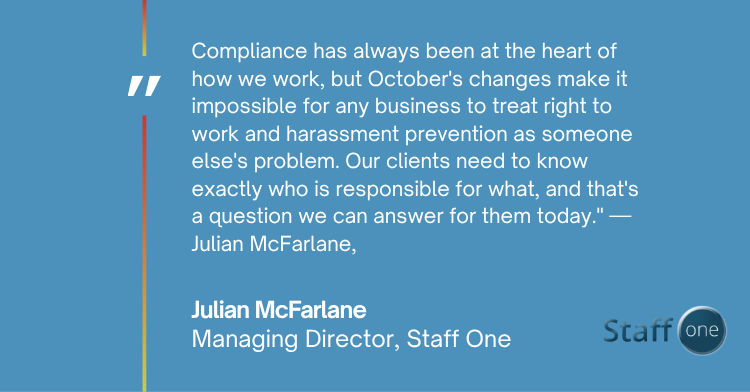
The pace of change in employment law is not slowing down, and the businesses that cope best are the ones that keep compliance close to how they actually hire. That is especially true for organisations that rely on temporary, contract and agency staff, where responsibilities are shared and the right to work and harassment rules now reach further than ever.
If you are looking for a recruitment partner that takes compliance as seriously as you do, across construction, engineering, healthcare and IT, get in touch with Staff One to find out how we can support you.
Sources
- Acas: Employment Rights Act 2025 changes
- Pinsent Masons Out-Law: Employment Rights Act implementation timeline
- Osborne Clarke: Regulatory Outlook, July 2026
- Osborne Clarke: Right to work liability extends along supply chains
- Howes Percival: Right to work checks are expanding from 1 October 2026
- Irwin Mitchell: Duty to inform workers of union rights delayed
- Bates Wells: Employment Rights Act timeline
- NHS Employers: October employment law changes